Almost Everyone Is Statistically Behind - What's The Point?

Greatness.
In the past, one’s reach was geographically limited. A baker from Africa would perhaps never cross paths with bakers from Asia, Europe, or America. Festinger’s Social Comparison Theory, that humans determine their own worth and abilities relative to others was less important here as very few actually knew and were in contact with many - the vast majority of people were around the small group of people in their town or area for most of their lives.
Modernity annihilated this equilibrium. The rise of the internet did not merely globalise information; it also globalised comparison. Now, any individual could, at any time, see somebody else who was: smarter, faster, stronger, more attractive, richer, more disciplined, or surpassing them in any other metric. Considering the wide range of people on the internet, there is a very good chance that most routinely come across such individuals.
What people once took time to find competition or somebody better than them, this time was shortened greatly by the internet, something which could mean constant exposure to those who are better than one. There was still, however, some chance of competition against these individuals because after all, most humans are not statistical outliers like Usain Bolt and hence are still comparable to.
As Buddhism teaches, though, everything changes eventually. This era of comparison, as mentally degrading as it could be for some, was about to be replaced by one far worse in this aspect. The era of AI.
Personally speaking, a few days after ChatGPT was released, I tried it out - I first asked it if it was evil (the influence of films such as Terminator), proceeding which, I asked it to write me a news report on a topic I had written on as well. While I had spent over an hour crafting mine, ChatGPT wrote one that was arguably more sophisticated and direct in about a minute. A minute.
After that, I started learning how to write more efficiently and quality simply to try to keep up with AIs - I became better, yes, but I was still hopelessly outclassed. At my peak, I can type at 143 words per minute - provided I know every single word to type and don’t have to think at all, a 1,000-word article would still take me almost 7 minutes to type, something which an AI would manage in less than half a minute. However, I do have to think and plan, and don’t know every word to type, which makes me far slower in the race.
However, some writers still argue that works written by AI are emotionally hollow and do not have the ‘human touch’, which makes AI faster at writing but still raises debate on the quality. Let’s consider a domain where human participants are thoroughly outmatched by AI - chess.
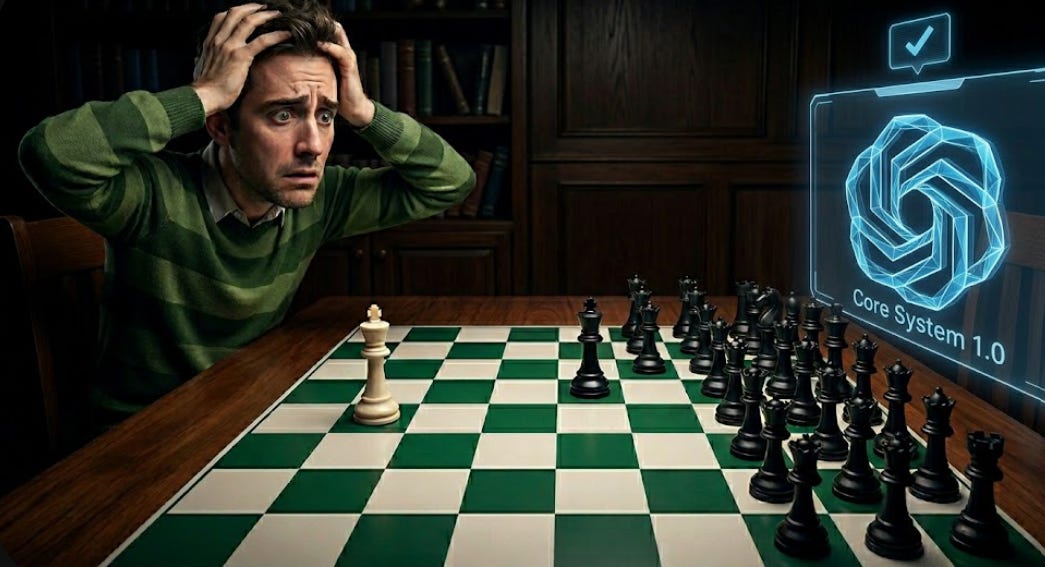
A game dating back centuries, it was a paradigm of what intellectuals preferred to play - a play of strategy, foresight, and calculation, which, when mastered, brings one immense global fame in today’s world. Magnus Carlsen, Praggnanandhaa, Hikaru Nakamura. Chess grandmasters were known as the epitome of strategic brilliance, the peak of the peak.
Of course, this was before the birth of modern chess engines. They did not merely beat humans - they operated on a scale so absurd that comparison became meaningless.
Under purely competitive logic, this should have killed competitive chess. Players who have obsessed over boards for years have not scratched a chess ELO rating of 3,000 while the latest Stockfish-18 engine hit 4,000. Why, then, do so many people still study, play, learn chess if it is evident that there is no plausible way they will ever even come close to engines that are constantly evolving?
The thing is, purely competitive logic also assumes superiority as the sole source of meaning. While being relatively good at something is obviously a drive - after all, so many people push themselves to be better at something simply because there are others better than them. However, statistically speaking, almost every single player or participant in an activity is not going to become the best at that activity and they are aware of this. There are millions of table tennis players worldwide - almost none of them will ever come even close to the level of play of Chinese legend Ma Long. Yet, they continue playing.
Despite this knowledge, people continue sketching, coding, dancing, singing, studying, competing, lifting weights, building things, analysing films, discussing philosophy, and playing chess.
Curiously, this persistence may reveal the actual point of skill.
Perhaps the purpose of mastery was never supremacy. After all, very few meaningful human experiences operate through absolute comparison. A sunset does not lose its beauty because another sunset exists elsewhere. Conversation, curiosity and discovery are experiences that possess intrinsic value - value independent from global rankings.
Chess itself illustrates this strangely well. The emotional reality of finding a brilliant move over the board remains intact despite artificial intelligence perceiving millions better ones instantly. The experience still matters to the player experiencing it. Not because they conquered the game universally. But because they momentarily touched something intellectually beautiful within it.
This perhaps explains why some of humanity’s most fulfilled individuals are not necessarily the greatest within their domains. Often, they are merely deeply engaged. The scientist obsessed with elegant questions. The musician immersed in sound itself. The writer fascinated by ideas. Their relationship with the craft becomes less territorial and more intimate.
The point of something may therefore not be victory in any absolute sense. Perhaps the point is transformation.
To engage deeply with something difficult enough that it alters perception. To encounter beauty, frustration, elegance, limitation, obsession, failure, and growth through participation itself.
And perhaps that is why humanity continues creating, competing, and learning despite knowing somebody else will always surpass them eventually.
Because meaning was never located solely at the top of the hierarchy.
It was located in the act of climbing.
Nice one , Neil !